Staphylococcus aureus report
- Version:
0.6.5
- Date:
Nov 20, 2023
We followed the standard European external Quality Control (EQC) project [2] to standarize the reported results when S. aureus samples are analyzed.
Genes to report
A list of important genes is provided in file:
Gene |
Synonym |
Definition |
|---|---|---|
mecA |
PBP2A |
A foreign PBP2a acquired by lateral gene transfer that able to perform peptidoglycan synthesis in the presence of beta-lactams. |
mecC |
mecALGA251 |
A foreign PBP2a acquired by lateral gene transfer that able to perform peptidoglycan synthesis in the presence of beta-lactams. |
mupA |
ileS2 |
An alternative isoleucyl-tRNA synthetase conferring resistance to mupirocin. |
cfr |
cfr cfr(A) |
CfrA is a chloramphenicol-florfenicol resistance gene and methyltransferase enzyme. Methylation of 23S rRNA confers resistance to chloramphenicol antibiotics |
tetK |
tetK |
TetK is a tetracycline efflux protein found in both Gram-negative (Haemophilus and Gallibacterium) and Gram-positive (many species, including mycobacteria) bacteria. |
tetM |
TetM is a ribosomal protection protein that confers tetracycline resistance. It is found on transposable DNA elements and its horizontal transfer between bacterial species has been documented. |
|
ermA |
ermTR |
ErmA confers the MLSb phenotype. Similar to ErmC, Expression of ErmA is inducible by erythromycin. The leader peptide causes attenuation of the mRNA and stabilizes the structure preventing further translation. When erythromycin is present, it binds the leader peptide causing a change in conformation allowing for the expression of ErmA. |
ermC |
ErmC’ ermIM ermM |
ErmC is a methyltransferase that catalyzes the methylation of A2058 of the 23S ribosomal RNA in two steps. Expression of ErmC is inducible by erythromycin. The leader peptide causes attenuation of the mRNA and stabilizes the structure preventing further translation. When erythromycin is present, it binds the leader peptide causing a change in conformation allowing for the expression of ErmC. |
aph3 |
APH(3’)-IIIa is a plasmid-encoded aminoglycoside phosphotransferase in S. aureus and Enterococcus spp. |
|
aadC |
aadD aadD2 |
ANT(4’)-Ia is a plasmid-encoded aminoglycoside nucleotidyltransferase in S. epidermidis, S. aureus, Enterococcus spp. and Bacillus spp. |
aac-aphD |
aac(6’)-bifunctional, aacA-aphD, APH(2’’), aph(2’’)-bifunctional, AAC(6’)-APH(2’’) |
AAC(6’)-Ie-APH(2’’)-Ia is an aminoglycoside acetyltransferase encoded by plasmids and transposons in S. aureus, E. faecalis, E. faecium and Staphylococcus warneri |
lukF_PV |
Panton-Valentine leukocidin chain F precursor |
|
lukS_PV |
Panton-Valentine leukocidin chain S precursor |
|
tst |
tsst-1 |
Toxic shock syndrome toxin-1. Membrane acting superantigen |
sea |
staphylococcal enterotoxin A |
|
seb |
staphylococcal enterotoxin B |
|
sec1 |
staphylococcal enterotoxin C1 |
|
sec3 |
staphylococcal enterotoxin C3 |
|
sed |
staphylococcal enterotoxin D |
|
see |
staphylococcal enterotoxin E |
|
seh |
staphylococcal enterotoxin H |
|
eta |
Exfoliative toxin A |
Primarily responsible for the skin manifestation of staphylococcal scalded skin syndrome and bullous impetigo |
etb |
Exfoliative toxin B |
Primarily responsible for the skin manifestation of staphylococcal scalded skin syndrome and bullous impetigo |
etd |
Exfoliative toxin D |
|
arcA |
arginine deiminase |
SCCmec
The staphylococcal cassette chromosome (SCC) is a gene cassette widely disseminated in staphylococci. SCCmec is characterized by the carriage of methicillin resistant determinant gene (mecA).
Structural characteristics of SCCmec elements.
They carry the class A mec gene complex, consisting of mecA, its regulatory genes, mecI and mecR1, and the insertion sequence IS431.
They carry a ccr gene complex (ccr).
They carry two site-specific recombinase homologues.
They have characteristic direct repeats and inverted repeats at both ends.
They integrate into ISS (integration site sequence for SCC), which is located at 3’ end of orfX. It is located at the 3’ end of orfX.
For additional details, visit:
SCCmec typing
The type of SCCmec is defined by the combination of the type of ccr-gene complex and the class of mec-gene complex [3]. Subtype of the SCCmec is based on the difference in the J regions (standing for junkyard): J1, J2, and J3.
ccr |
mec |
combination ccr and mec |
SCCmec type |
|---|---|---|---|
type 1 |
class B |
1B |
Type I |
type 2 |
class A |
2A |
Type II |
type 3 |
class A |
3A |
Type III |
type 2 |
class B |
2B |
Type IV |
type 5 |
class C |
5C |
Type V |
type 4 |
class B |
4B |
Type VI |
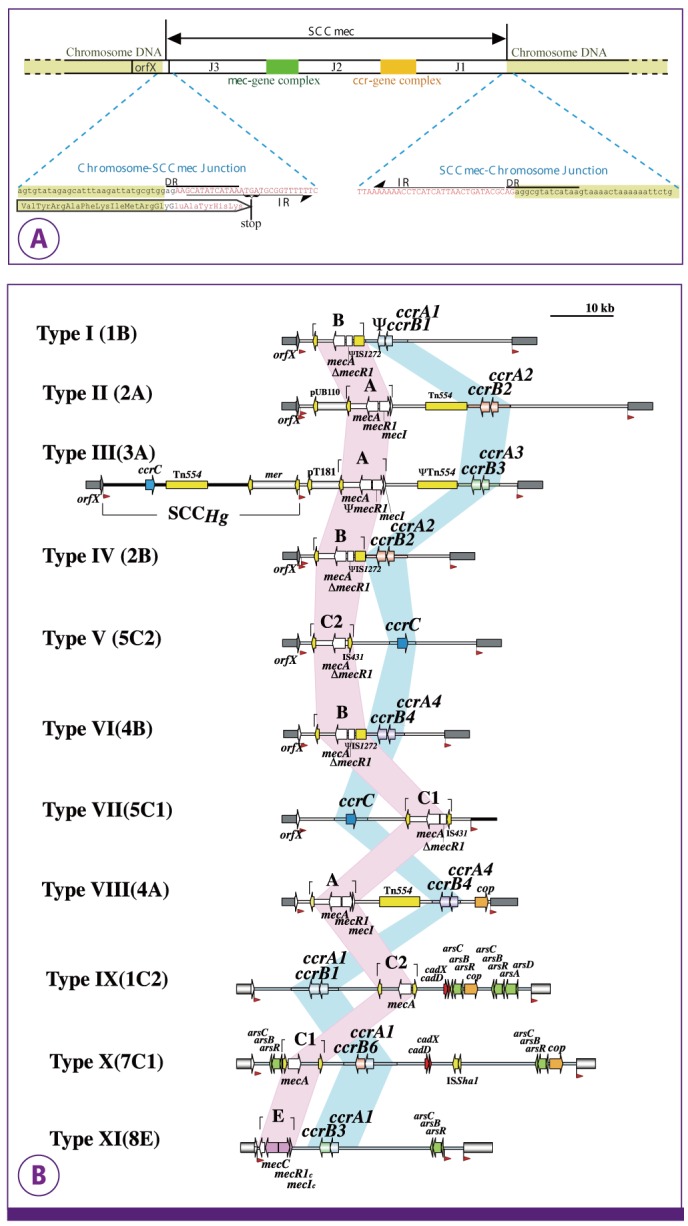
Original source: Hiramatsu et. al. 2013 (PMID: 24265961)
(A) Basic structure of SCCmec. SCCmec is bracketed by direct repeats (DRs) that contain integration site sequence (ISS) recognized by cassette chromosome recombinase (CCR). A pair of inverted repeats (IRs) are present at the termini of SCCmec.
(B) Various types of SCCmec. The structures of 11 types of SCCmec are illustrated based on the nucleotide sequences deposited in the DDBJ/EMBL/GenBank. See original source for additional details.
Direct repeats that comprise integration site sequences of SCC are located at both extremities of SCCmec (the red arrowheads). The location of five (A-E) classes of mec-gene complexes is indicated by pink belt. The locations of ccr-gene complexes are indicated by blue belt. Insertion sequences and transposons are indicated in yellow. Representative genes related to heavy metal resistance and integrated plasmids located in the J regions are also indicated. Type XI is a newly identified SCCmec found in the MRSA strains of bovine sources.
SCCmec database
We would use SCCmecFinder
SPAtyping
The spa typing method is based on sequencing of the polymorphic X region of the protein A gene (spa), present in all strains of Staphylococcus aureus. The X region is constituted of a variable number of 24-bp repeats (exceptions of 21 to 30 exist) flanked by well-conserved regions. Due to its repeat structure, the spa locus simultaneously indexes micro- and macrovariations, enabling the use of spa typing in both local and global epidemiological studies [4].
Establishment of standardized spa type nomenclature and Internet shared databases is crucial for the success of this typing method. The most important and reference database for this purpose is the SeqNet/Ridom Spa Server.
Each new base composition of the polymorphic repeat found in a strain is assigned a unique repeat code. The order of specific repeats for a given strain determines its spa type.
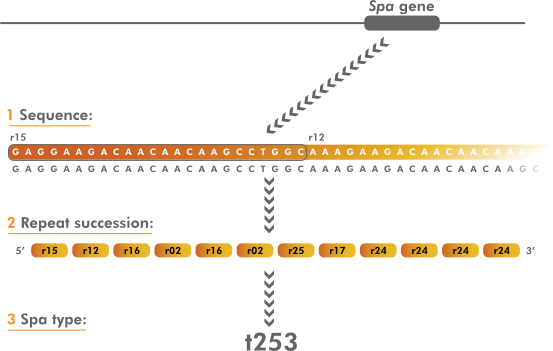
Original source: Applied Maths Bionumerics website. First, a repeat classification is generated. Then, based on the specific repeat order the spa type is determined.
BacterialTyper relies on a python module named spaTyper (https://github.com/JFsanchezherrero/spa_typing,
https://pypi.org/project/spaTyper/) (developed in collaboration with Mitchell Sullivan). This module automatically
synchronizes repeats and spa type signatures with the SeqNet/Ridom Spa Server and identifies spa protein in a given assembly.
It automatically retrieves repeats from: http://spa.ridom.de/dynamic/sparepeats.fasta and spa types from http://spa.ridom.de/dynamic/spatypes.txt
Here we show an example of SPA repeats:
>r01
GAGGAAGACAACAACAAGCCTAGC
>r02
AAAGAAGACAACAAAAAACCTGGC
>r03
GAGGAAGACAATAACAAACCTGGT
>r04
GAGGAAGACAATAACAAGCCTGGT
>r05
AAAGAAGACAACAAAAAGCCTGGC
...
And an example of SPA typing:
Spa Type |
Spa Repeat combination |
|---|---|
t1676 |
15-12-16-02-16-02-25-17-24-24-24-17 |
t1677 |
11-19-12-12-17-34-24-34-22-25 |
t1678 |
11-19-12-21-17-34-24-02-22-25 |
t1679 |
26-23-66-34-17-20-17-12-17-16 |
t1636 |
14-44-13-12-17-17-17-17-17-17-23-18 |
t1637 |
14-44-13-12-18 |
t1638 |
14-54-44-13-12-17-17-17-17-23-18 |
t1696 |
124-22-34-17-20-17-12-17-16 |
t1639 |
07-16-34-12-12-23-02-12-23 |